

A portfolio transaction may move forward as one deal, but every property within it has its own history.
One site may have operated as a commercial property for decades. Another may have a former industrial use or be located near a property with a history of environmental concerns. A third may have an existing environmental report that needs to be evaluated for the current transaction.
For buyers, lenders, and investors, the challenge is understanding those individual property conditions while keeping the larger transaction moving forward.
That requires more than completing a checklist of reports. It requires a coordinated process that brings property information, assessment activities, findings, and deadlines together in a way that supports the decisions ahead.
Why Portfolio Due Diligence Requires a Coordinated Approach
In a multi-property transaction, environmental due diligence often involves more than one property type, location, and site contact. The team may also be working with different sources of information, lender requirements, and closing schedules.
For example, a portfolio of ten properties may include several sites with similar current uses. Their histories, however, may be very different. One property may have a former fuel storage area. Another may be near a historical industrial operation. A third may have a previous investigation that needs further review.
The transaction team needs to understand those differences without losing sight of the overall assignment.
A coordinated approach helps stakeholders answer questions such as:
- Which properties have been assessed?
- What information or site access is still needed?
- Which findings require discussion?
- Could additional investigation be appropriate?
- How do outstanding questions relate to the transaction schedule?
The value is having a clear view of both the individual property and the portfolio as a whole.
Start by Defining the Transaction Requirements
Before assessment activities begin, the environmental consultant and transaction team should discuss the properties involved, the intended report users, and the decisions the work needs to support.
A useful starting package may include:
- Property names, addresses, and available site boundaries
- Surveys, site plans, or other property descriptions
- Owner, operator, or property manager contacts for site access
- Known historical and current uses
- Previous environmental reports
- Existing regulatory correspondence
- Lender requirements and intended report users
- Planned renovations, redevelopment, or changes in use
- Anticipated closing dates and other decision deadlines
Not every item will be available for every property. Identifying what is available and what is missing early helps the project team establish the scope, organize access, and plan for follow-up.
Review Existing Reports Before Relying on Them
Previous environmental reports can provide useful background, but they should not automatically be assumed to meet the needs of a new transaction.
The team should consider when a report was completed, the scope of the assessment, the parties for whom it was prepared, and whether the current parties can rely on it. Changes in property use or newly available information may also be relevant.
When all appropriate inquiries applies to an acquisition, timing and other requirements must be considered. The project team should discuss the transaction’s objectives and applicable requirements with its environmental and legal advisors.
Different Asset Types Raise Different Questions
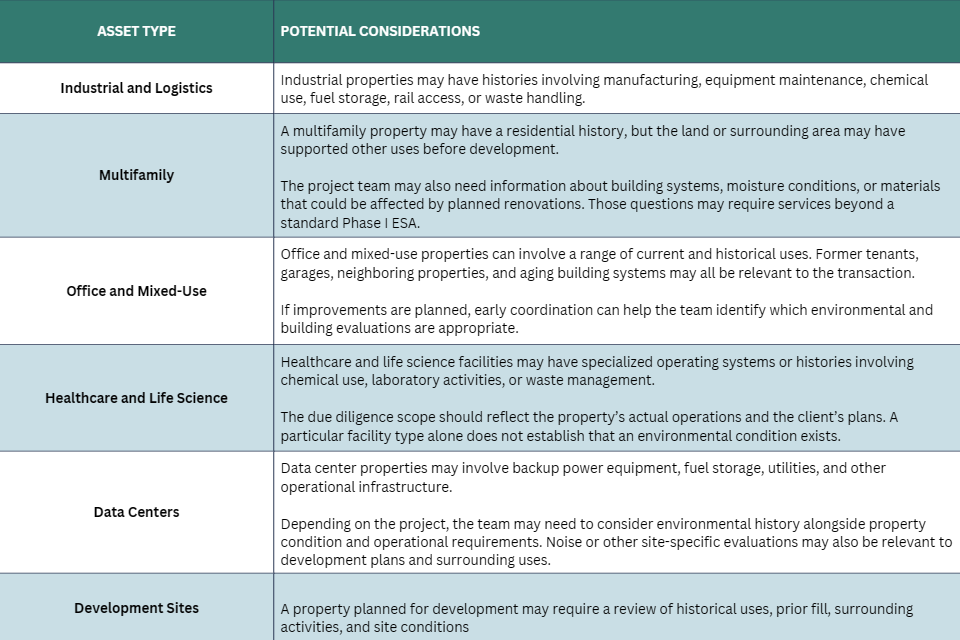
Depending on the project, the team may need to consider environmental history alongside property condition and operational requirements. Noise or other site-specific evaluations may also be relevant to development plans and surrounding uses.
What a Phase I ESA Is Designed to Do
A Phase I Environmental Site Assessment evaluates available information about a property’s environmental history and current conditions.
The process generally includes:
- Historical research
- Review of regulatory records
- Interviews
- Site reconnaissance
- Evaluation and reporting by an environmental professional
The assessment is intended to identify recognized environmental conditions, often called RECs, and document relevant findings and significant data gaps.
For a portfolio client, the results help the team understand what was identified at each property and which findings may need further discussion within the larger transaction.
A Phase I ESA does not prove that a property is free of contamination. It also does not automatically include every building or property-related evaluation a client may need.
When One Property Requires Follow-Up
A finding at one site does not automatically describe the rest of the portfolio. It does, however, deserve attention in the context of the transaction.
A project team may need to review additional records, understand the status of a previous investigation, or discuss whether a Phase II Environmental Site Assessment would help answer an unresolved question.
When a Phase II is appropriate, the scope should be tied to the specific condition being evaluated. Depending on the site, the investigation may include sampling soil, groundwater, or soil vapor.
Connecting Property Detail to the Portfolio View
A coordinated delivery approach should help clients understand the status of the overall assignment while preserving the detail needed for each site.
At the beginning of a project, the team can align on scope, site access, report users, schedule, and communication expectations. As assessment activities move forward, property-specific questions can be discussed with the appropriate stakeholders.
For larger assignments, a portfolio summary or tracking method may help organize:
| Information | Purpose |
|---|---|
| Property and location | Identify the site being discussed |
| Assessment status | Show where the work stands |
| Outstanding information | Identify records, access, or other items still needed |
| Findings requiring discussion | Highlight property-specific questions |
| Potential next action | Support a decision about follow-up |
| Timing and responsible contact | Connect the work to the transaction schedule |
The format and level of reporting should be agreed upon as part of the project scope.
Considering the Building Alongside the Site
Environmental history is one part of understanding a property. Depending on the transaction and the client’s objectives, the team may also need to evaluate building condition, potential capital needs, or materials that could be affected by planned work.
Phase Engineering can discuss separately scoped services such as:
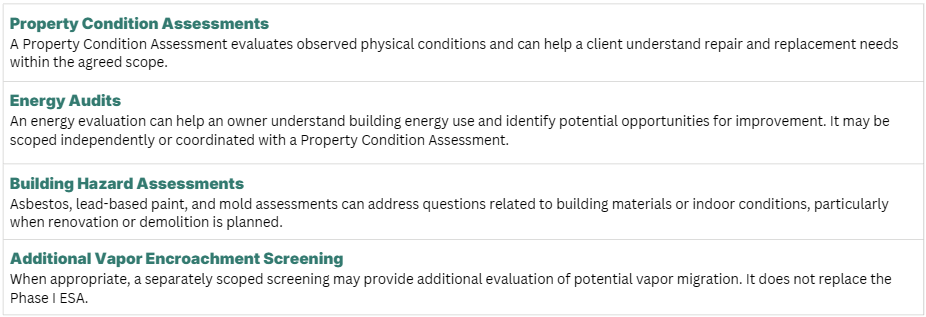
Coordinating these services can help the project team understand how environmental conditions, building needs, and planned improvements relate to one another.
How Phase Engineering Supports Portfolio Transactions
Phase Engineering helps buyers, lenders, developers, and investors evaluate environmental and property conditions across individual sites and multi-property portfolios.
Our team works with clients to establish project requirements, coordinate assessment activities, and communicate property-specific findings in the context of the broader assignment.
Since 1993, Phase has supported real estate decisions through environmental assessments, building services, investigation, and remediation-related work.
Whether a client is evaluating several properties in one market or a portfolio across multiple states, the objective is the same: understand the questions associated with each property and provide useful information for the decisions ahead.
Discuss Your Portfolio With Phase Engineering

