
Before purchasing commercial property, you need to understand its environmental history as well as its current condition. A Phase I Environmental Site Assessment (ESA) brings together historical research, regulatory records, interviews, and site observations to evaluate environmental conditions associated with the property.
At Phase Engineering, we provide Phase I and Phase II ESAs to support real estate due diligence. Our work helps purchasers and developers identify and evaluate environmental concerns before finalizing a property transaction.
For a buyer, the value is having a documented basis for the next decision. What does the evidence establish? Which questions remain unresolved? Is further investigation warranted before you take ownership? A Phase I ESA helps put those questions in context.
Looking beyond the property walkthrough
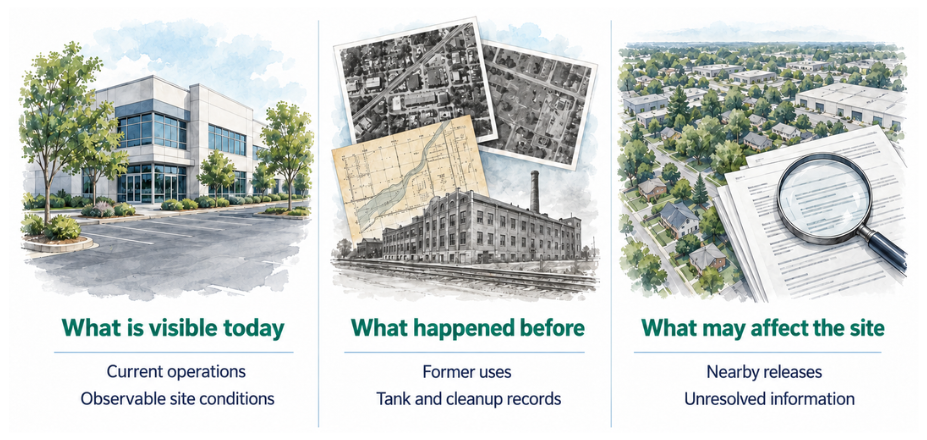
A site visit is one part of a Phase I ESA. Historical photographs, maps, property records, and environmental databases provide information about former uses and reported environmental conditions. Interviews add information about site operations that may not be apparent during a walkthrough.
Our Phase I services follow EPA’s All Appropriate Inquiries (AAI) rule and ASTM’s Phase I assessment framework. The assessment considers the subject property and relevant adjoining or nearby conditions. A historical use or regulatory listing requires evaluation in context; it does not, by itself, establish contamination at the property.
Explaining which findings deserve attention
Professional judgment is central to the assessment. Under ASTM E1527-21, a recognized environmental condition (REC) can involve hazardous substances or petroleum products at a property because of a release, or their likely presence because of a release or likely release. It can also involve substances present under conditions posing a material threat of a future release.
The environmental professional evaluates the evidence and documents the basis for the conclusion. The report also identifies significant data gaps when missing information affects the ability to evaluate conditions indicating a release or threatened release.
Phase Engineering’s due diligence services include regulatory data reviews, environmental data risk reviews, and third-party peer reviews. This work supports a practical discussion about what the available information means for the property being evaluated.
When reviewing the findings with your project team, focus on four questions:
- What condition was identified, and what evidence supports the conclusion?
- Can additional records help resolve an unanswered question?
- Is further investigation warranted, and what should it evaluate?
- What needs to be addressed before the next transaction milestone?
Defining the next step when investigation is warranted
Soil and groundwater sampling are generally outside the standard Phase I scope. A Phase II ESA uses sampling and laboratory analysis to investigate potential contamination. Its scope should follow the findings and the conditions at the property.
Phase Engineering provides Phase II investigations that can include soil, soil vapor, groundwater, and air sampling. When additional investigation is appropriate, this capability allows us to help clients evaluate concerns identified during due diligence in greater detail.
The question driving the investigation should be clear before the work begins. Ask what uncertainty the proposed sampling will address and how the results will inform your next decision.
Connecting the assessment to your acquisition
A Phase I ESA reduces uncertainty within its defined scope. It does not guarantee a property is free of contamination or address every building condition. If renovation or redevelopment is planned, discuss whether separate asbestos, lead-based paint, or other evaluations are appropriate. Phase Engineering’s Building Services include asbestos and lead-based paint assessments.
Work with Phase Engineering before you commit
Phase Engineering has assessed environmental risk since 1993. Our due diligence services help clients evaluate environmental conditions before property transactions are finalized, with Phase II investigation available when further evaluation is warranted.
Start the conversation with your property address and boundaries, intended use, available environmental reports, and target closing date. That information helps establish the scope and identify questions to address at the outset.
Planning a commercial property acquisition? Contact Phase Engineering to discuss a Phase I ESA and the environmental due diligence needs of your transaction.

CONNECT WITH US
